hackerRank just open sourced their hiring agent. and it reveals way more than i expected.
A few weeks ago, HackerRank quietly open sourced something very interesting.
Their AI Hiring Agent.
At first glance, it looks like another AI project.
Upload a resume, get an evaluation.
Nothing special.
But after digging through the repository, I realized this is probably one of the most transparent looks we've ever gotten into how a modern AI-powered hiring system evaluates candidates.
For years, students have been guessing how ATS systems work.
Use more keywords.
Make it one page.
Use an ATS template.
Add more skills.
Remove graphics.
Most of us have never actually seen the evaluation process.
We upload our resumes.
Wait.
And then get rejected without any explanation.
This repository changes that.
For the first time, we can see exactly what an AI hiring system is looking for.
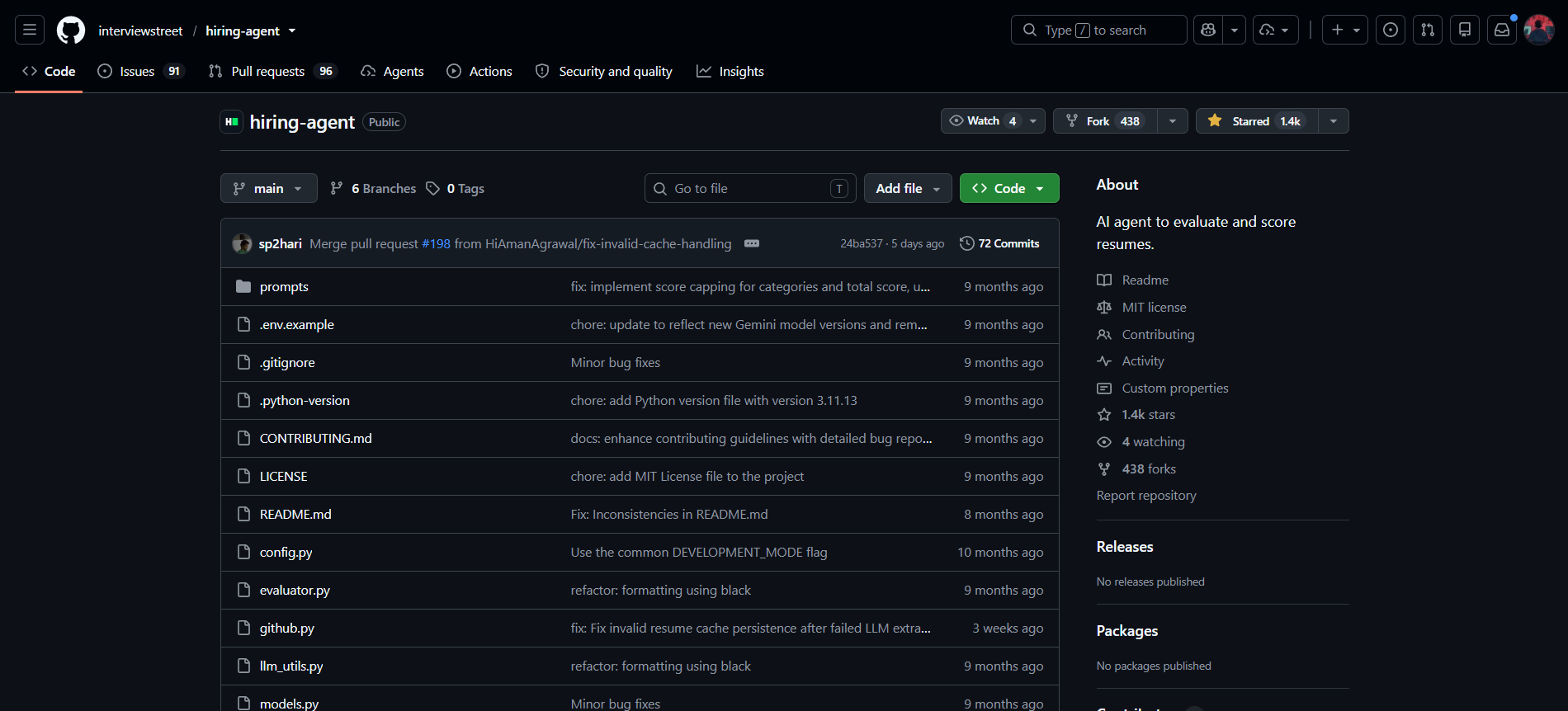
so what exactly is the hiring agent?
The Hiring Agent is essentially a resume-to-score pipeline.
You give it a resume PDF.
The system extracts the contents.
Converts everything into structured data.
Fetches GitHub information.
Analyzes projects.
Scores the candidate.
And generates a detailed evaluation report.
The interesting part is that it doesn't stop at the resume.
It actively looks at your GitHub profile and repositories as part of the evaluation process.
The pipeline looks something like this:
resume pdf
    ↓
extract information
    ↓
convert to structured profile
    ↓
analyze github profile
    ↓
rank projects
    ↓
evaluate candidate
    ↓
generate final score
And yes.
You can literally inspect how the scoring works.
That's what makes this repository so valuable.
the biggest surprise: personal projects are not enough
This was probably the most surprising thing I found.
The scoring system has an entire category dedicated to open source contributions.
Not GitHub activity.
Not personal repositories.
Actual open source contributions.
The repository explicitly states that personal repositories do not count as open source contributions.
The system checks whether you've contributed to projects owned by other people and whether those projects involve multiple contributors.
That means:
personal portfolio website
personal todo app
personal weather app
personal movie recommender
are treated very differently from:
contributing to an existing project
submitting pull requests
fixing issues
working with maintainers
collaborating with other developers
Honestly, I didn't expect the distinction to be this clear.
hackerRank gives open source the highest weight
The evaluation system is split into multiple categories.
Here's the weight distribution:
| Category | Maximum Score |
|---|---|
| Open Source Contributions | 35 |
| Self Projects | 30 |
| Production Experience | 25 |
| Technical Skills | 10 |
Open source contributions receive the highest weight.
That's huge.
Most students spend years building personal projects while completely ignoring open source.
According to this scoring system, that might not be the best strategy.
hacktoberfest alone won't help much
Another interesting detail.
The system specifically mentions Hacktoberfest participation.
If a candidate's only open source activity is Hacktoberfest without meaningful contributions, the score gets capped and can even trigger deductions.
I found this fascinating because a lot of students treat Hacktoberfest as their entire open source journey.
The repository makes it pretty clear that meaningful contributions matter much more than participation badges.
your github repositories are being classified
The system doesn't just fetch repositories.
It classifies them.
Repositories are categorized into:
- open_source
- self_project
The agent checks contributor information and repository activity to make this distinction.
Then it uses an LLM to select the candidate's top projects before evaluation.
So the hiring system isn't simply counting repositories.
It's trying to understand which projects actually represent your strongest work.
project links matter more than i expected
One thing that appears repeatedly throughout the scoring criteria is verification.
Projects without links lose points.
Projects with broken links lose points.
Projects with inactive demos lose points.
Projects with working demos can receive a score boost.
This makes sense.
A project that cannot be verified is much harder to evaluate.
Which means that simply listing projects on a resume may not be enough.
The supporting evidence matters too.
blogs can actually earn bonus points
This one genuinely surprised me.
The system includes bonus points for candidates who write quality technical blogs.
Not everyone has internships.
Not everyone has production experience.
But anyone can document what they learn.
Seeing technical writing included in the scoring system was unexpected.
And honestly, pretty cool.
what the system deliberately ignores
This might be my favorite part of the entire repository.
The evaluation rules explicitly prevent scoring based on:
- college name
- university name
- GPA
- CGPA
- location
- demographics
- personal information
The scoring focuses on technical evidence instead.
Whether every hiring system follows these principles is another discussion.
But it was refreshing to see those rules written directly into the evaluation framework.
why this repository matters
The code itself is interesting.
The scoring system is interesting.
But the biggest value is transparency.
Most ATS systems feel like black boxes.
You submit a resume.
Something happens.
You get a rejection.
And you never know why.
This repository gives us something we rarely get.
Visibility.
We can finally see what an actual hiring evaluation pipeline values.
Not through speculation.
Not through LinkedIn advice.
Not through YouTube thumbnails.
Through code.
And that's incredibly valuable.
try it yourself
One of the best parts is that HackerRank made the entire project open source.
You can clone the repository.
Run it locally.
Feed it your own resume.
Inspect the evaluation.
Read the prompts.
Analyze the scoring criteria.
And see exactly what the system thinks about your profile.
Whether you're a student, developer, or someone preparing for placements, it's worth exploring.
Repository:
https://github.com/interviewstreet/hiring-agent
final thoughts
I don't think this repository teaches us how to game ATS systems.
I think it teaches us something much more useful.
It shows what signals an actual AI hiring system considers valuable.
Open source contributions.
Strong projects.
Verifiable work.
Technical writing.
Real evidence.
And most importantly, it removes some of the mystery around resume evaluation.
So shout out to HackerRank for making this public.
Open sourcing a project like this gives students and developers a rare opportunity to understand a process that has usually been hidden behind closed doors.
And honestly, I wish more companies did this.